Showing posts with label budget. Show all posts

Thursday, May 26, 2011

Response to the House Republican Plan for America's Job Creators

The full document can be read here: http://www.majorityleader.gov/Jobs/HRP_JOBS.pdf. I will abbreviate this initially as the "Republican Jobs Plan," and when I get tired of typing that out, "RJP." Overall, the plan was vague to the point of uselessness, misleading in a number of areas, and economically dubious.

For the past four years, Democrats in Washington have enacted policies that undermine these basic concepts which have historically placed America at the forefront of the global marketplace. As a result, most Americans know someone who has recently lost a job, and small businesses and entrepreneurs lack the confidence needed to invest in our economy.
Contrary to popular Republican belief, it is not entirely the fault of Democrats that we are in a recession. Contrary to popular Democratic belief, it is not entirely the Republicans' fault, either. For example, we can turn to the omniscient Wikipedia: http://en.wikipedia.org/wiki/Causes_of_the_late-2000s_recession. This article briefly discusses many causes which can be traced back to one party or the other, and in many cases both. There's a reason that the country is dissatisfied with virtually all elected officials, and not just one party. The implication in the Republican Jobs Plan that we should think "Democrats' fault!" when we think of anyone that's lost a job is insulting to the complexity of the various causes, and shows a lack of integrity. Own your mistakes! And yes, that applies to all politicians.

Businesses, small or otherwise, do not invest in our economy - they invest in themselves to make an increased profit. Businesses create products or services to sell. That means they have to see (or create) a market. A business will not form or expand if there is not a market - why go into the business of selling something if you have nowhere to sell it? The market is a collection of people or other businesses that have money and a need or desire for your product. A good business idea will cover the "need or desire for your product" side of the market. People only spend money when they have it, or spend credit when they can reasonably expect to have money soon. Americans are referred to by both parties as innovators, entrepreneurs, and creative people. There are plenty of ideas being generated even in today's economy. What we have is too many people with too little money, and thus a lack of markets - a lack of demand to the Econ 101 folks out there.

Cutting taxes for the wealthy also does not create jobs, by and large. The wealthy don't hire people because they have more money to throw away. When they hire people, they hire them because they need to in order to get something done and/or make more money. When do they need to hire someone in order to make more money? When there are untapped markets. In general, business is very efficient at exploiting markets, and markets are inefficient at arising spontaneously and seeking out businesses. It seems to me that government economic stimulus, when needed, should focus on market creation and sustainability over business investment.

Democrats argue that income inequality and accumulated wealth inequality is unfair. Some aspects of that argument are compelling, but that is a topic for another day. Republicans argue that the inequality arises out of merit and hard work, which is only sometimes true, but is also a topic for another day. I would argue that income and wealth inequality is more a question of sustainability. Essentially, some businesses and individuals have become so successful that they have begun to destroy their own markets. They have accumulated so much wealth that not enough is left over for the bottom 21-40% (http://www.offthechartsblog.org/public-programs-keep-millions-out-of-poverty-new-study-shows/) to get by on their own. This means they spend less, which lowers overall demand, which lowers the incentive for businesses to expand.

Government takeovers of the economy have failed while the size and the scope of the federal government has exploded.
Generally speaking, the government has not taken over sectors of the economy. Health care is still provided by private enterprises. There was a temporary, partial takeover of GM, which is ending successfully. There is increased regulation in many areas, but that is not necessarily a bad thing. It can be argued that these new regulations expand the scope of the federal government, but the number of federal employees has been remarkably stable (http://www.opm.gov/feddata/HistoricalTables/TotalGovernmentSince1962.asp).

Background: The House has already acted on several regulations that hurt job creators both large and small including: The EPA’s regulation of greenhouse gases, the Federal Communications Commission’s net neutrality proposal, and duplicative and burdensome pesticide regulations.
The Supreme Court ruled that the EPA did have the authority to regulate greenhouse gases as pollutants, despite the EPA's claim to the contrary. I can only guess that the RJP (look at that, tired of typing already) mentions greenhouse gases in particular because of the public perception that global warming is dubious science. There are a number of sites devoted to debunking global warming skeptics, but it should be noted that there is strong agreement among climate scientists - those that are acknowledged to know the most about it: 97-98% of the most active climate scientists agree (http://www.pnas.org/content/early/2010/06/04/1003187107.full.pdf+html).

Net neutrality is very important to the free exchange of ideas on the internet. See http://en.wikipedia.org/wiki/Network_neutrality for an overview. It is by no means a clear-cut issue, and it is highly technical in nature. Neither side has gotten it exactly right (Democrats are closer, in general, on this one), but no regulation is definitely not the answer. At least, not until the broadband companies do not have monopolies or near-monopolies in many markets.

Duplicative regulations of any type should be eliminated. Pesticides fall into the category of things that most people think should be regulated, though. DDT comes to mind, along with the very simple fact that pesticides are used to kill living creatures, and I am a living creature. I think demonstrating that the product you want to spray on my food is not going to kill me is a great regulation to have. I think it should be just as burdensome as it needs to be in order to ensure that I don't die. I cannot emphasize enough how much I do not want to die.

Congress should eliminate the special interest tax breaks that litter the code and reduce the overall tax rate to no more than 25% for businesses and individuals including small business owners.
...
At a combined state and federal rate of just over 39%, the U.S. currently has the second-highest corporate tax rate among the developed nations of the world (those in the OECD).
First, the effective tax rate has been estimated to be much lower than the statutory rate cited in the RJP (see http://mediamatters.org/research/201004260006). Second, President Obama called for a similar overhaul of the corporate tax system in his 2011 State of the Union address: "So tonight, I’m asking Democrats and Republicans to simplify the system. Get rid of the loopholes. Level the playing field. And use the savings to lower the corporate tax rate for the first time in 25 years –- without adding to our deficit. It can be done." (See http://www.whitehouse.gov/the-press-office/2011/01/25/remarks-president-state-union-address.) The question, then, is why are you complaining about the problem instead of actively working to fix it? Also, lowering the tax rate of individuals should be a separate debate from the corporate tax rate.

Finally, the three bullet points in the "Republican Solution" to this section are all the same point - that corporate profits earned overseas shouldn't be taxed again here (much). Either admit to the fact that your solution is only one bullet point long, or think up solutions that require three bullet points.

For more than three years free trade agreements with Colombia, Panama, and South Korea have sat idle, blocked by House Democrats’ political posturing.
The FTA with Colombia has stalled due to human rights abuses in Colombia. (See http://www.hrw.org/americas/colombia, specifically http://www.hrw.org/en/news/2011/04/07/uscolombia-rights-conditions-crucial-trade-deal.) Human rights issues are not political posturing. The agreement with Panama was only finally recommended by the Obama administration on April 18, according to Bloomberg. At the bottom of that article is also a report of progress on the Colombian trade agreement.

The issues with the South Korea trade agreement seem to be more general, in that it doesn't help in certain key areas, such as off-shoring of both Korean and U.S. jobs to China, as described in the AFL-CIO's statement opposing it. Furthermore, Dean Baker, for example, has argued that free trade agreements do not actually promote free trade, and the Economic Policy Institute notes how NAFTA has not produced the net export gains claimed, and that the South Korean FTA is very similar.

Sometimes things are opposed for real reasons, and not just political posturing. Sometimes they are opposed for political posturing when they should be opposed for real reasons. This paragraph in the RJP is itself political posturing and does not further the debate.

Possible solutions include keeping the most accomplished graduates in math, science and other critical fields here in America as well as making it easier for start-up entrepreneurs to obtain visas.
I agree completely that motivated and skilled people should be encouraged to stay in the U.S. I take it that Republicans voted for the DREAM Act, which provided a path to citizenship to children who were brought here illegally, but through no decision of their own other than to stay with their parents? And only those children that were motivated enough to attend college or serve in the U.S. military? And then not be allowed to petition for family members until years later? Ah, no, Republicans nearly universally voted against it.

Since President Obama has taken office, American energy production has been halted and the average national price of gasoline has doubled.
American energy production has not been halted. There was a brief moratorium on new deep water drilling, but shallow drilling, land-based drilling, and all other non-oil energy production has continued, for better or worse. Also, it is not credible to blame the rising gasoline prices on Obama policies, even if only by implication (See http://mediamatters.org/research/201103140030 and http://mediamatters.org/research/201103310023 and http://mediamatters.org/research/201103030007).

President Obama and congressional Democrats have overseen the largest budget deficits in the history of the U.S. In the last two years, non-defense discretionary spending has increased by over 80%. They’ve maxed out our nation’s credit cards and are asking us to increase their credit limit so they can spend more.
I would guess that this figure includes the stimulus spending. Dean Baker is worth reading on this topic: http://www.cepr.net/index.php/blogs/beat-the-press/politico-has-not-heard-about-the-collapse-of-the-housing-bubble-and-economic-crisis. In general, accurately assigning blame for the budget deficit is not going to benefit Republicans. There is a reason Democrats point to studies like this: http://www.cbpp.org/cms/?fa=view&id=3036, and Republicans only talk about total spending amounts. Again, it's time for politicians on both sides to own their mistakes, and this attempt to pin the blame on Obama and Democrats exclusively is not welcome.

Speaking of owning mistakes, Obama has done just that in regards to the debt ceiling (See http://www.huffingtonpost.com/2011/04/11/obama-debt-ceiling-vote_n_847627.html). The debt ceiling itself is really not a political issue. It is a necessity if you want to preserve our role in the world financial markets. Deficit spending is more of a political issue, but the debt ceiling should not be tied to it.


This is not meant to be an exhaustive enumeration of all my thoughts on all these issues. If you would like to respond to any statements I've made, I welcome the discussion so long as it remains civil. A full explanation of my political stances is on my eventual to-do list. Debating the issues is how I've arrived at the positions I currently hold, and I always welcome the opportunity to refine my positions further - or even throw them out in favor of better ideas. So please, do comment.

Wednesday, May 25, 2011

Insights from Mint.com

Going over my Mint.com trends for the past couple years, I noticed a few things I thought were somewhat cool. In no particular order:
  • 75% of my out-of-pocket expenses are for housing and communications - mortgage, property taxes, insurance, and all utilities including TV, Internet, and phone.
  • I spend more for Verizon Wireless than I spend at Walmart. To be fair, my Verizon bill covers five people. To be unfair, Walmart covers the majority of my grocery expenses and cat food and litter. To be fair again, I eat out quite a bit, so groceries are cheap.
  • I will also spend more for Verizon Wireless than I spend on eating out, once figures include a full 24 months of Verizon bills.
  • I spend a lot at Chili's ($800), and it is probably worth getting any discounted gift cards I see.
  • My expenses have actually gone up since I've started paying attention to them. Every month, I've spent more in 2010 than 2009. I've also had more cash on hand.
  • It's very important to set up renaming rules right when the name of a merchant changes for whatever reason. From that point on, it becomes automatic.
  • Rollover budgets are great in theory, but end up making the overall totals meaningless as they drift way negative or way over budget. Really, the budget feature itself is not as informative as the Trends tab.
  • "In the past 30 days, you spent $309.62 on Clothing. Usually you spend $9." That $9/month is inflated because it includes a tuxedo rental and a bunch of clothes that weren't actually mine. In other words, I spend very little on clothes.
  • It is also important to realize tax refunds are income that the government held for you, and not taxes. Assigning tax refunds to the 'Taxes' category can result in negative spending for the month, which looks awkward.

Wednesday, August 25, 2010

Infinite Retirement Calculator

As you may know, I plan on living forever. Dying just seems so wasteful, so I think I'll skip that part of life. Living forever requires some planning, though. It'd be rather annoying to retire and then be forced back into the workforce at age 2718 because I ran out of money. Every retirement calculator I've ever found requires you to choose how long you will be retired. The longest option I've seen is 120 years, but even that's rather pessimistic. So then, I need to know how much money I need to save up in order to retire - forever. Alternatively, I'd like to know how much I can take out every year given my current investments.

I tried to be as conservative as possible in my planning. I assumed I would take out the entire year's spending money at the beginning of the year, i.e., I was pessimistic about how much of my net worth would grow each year. Of course, this pesky little recession has shown that I'm being ridiculously optimistic by assuming any sort of consistent growth during my retirement. Still, this is for planning purposes only, and certain assumptions have to be made in order to make the math at all reasonable.

So, without further ado, the calculator!

  • Modify either the "Net worth" or the "Max sustainable income" field and the other will be calculated.
  • "Growth rate" and "Inflation rate" are configurable as well.
  • The bold label indicates the calculated value.
Net worth ($):
Growth rate (%):
Inflation rate (%):
Max sustainable income ($):
Monthly values?

For every $0.00 you save, your eternal retirement income increases by $1.00.

Some following ado is in order. It should be noted that the "Net worth" and "Max sustainable income" values are in current dollars. The amount you withdraw is assumed to adjust for inflation each year; your infinite retirement should maintain a consistent quality of life. Since money equals happiness, this means your purchasing power should remain the same no matter how long you live. Similarly, the "Net worth" (when calculated) is how much you would need today in order to retire. The amount you need goes up each year, since your income requirements get larger as you postpone your retirement, but most of the difference should be accounted for in the principal growth that would be occurring. It should also be noted that the amount you have to save per dollar is entirely dependent on the growth and inflation rates, so these are rather important to estimate right (and/or conservatively).

Observant readers may have noticed that the default inflation rate of 3.3% closely matches the annualized inflation rate discussed previously. They may have also noticed that the default growth rate of 7% does NOT match any of the numbers in my discussion on the annualized growth rate. I chose 7% because this calculator models retirement, and people tend to be more conservative in their retirement. I think 7% is a better reflection of a portfolio with a significant percentage allocated to bonds, for example.

The "Net worth" label is probably a bit misleading, but it gives you a good place to start. I would probably not include my home equity in these calculations because I don't plan on using that for income in any way. Similarly, cash accounts won't come close to the average growth most people assume in their models, and would probably best be ignored. I would have used "Retirement savings" except that term is usually used to refer to 401(k) and IRA accounts, and regular taxable accounts can grow and produce income, too.

Growth and inflation rates are APY values. The default values reflect yearly budgeting, and for yearly values, APR=APY and things are simple. When the "Monthly values?" checkbox is checked, the growth and inflation rates are adjusted such that the APY remains the same as for the yearly case, other than rounding errors. When looking at monthly values, your overall income will still be higher (or your net worth needed lower) because you are leaving your money growing a few months longer.

Friday, August 20, 2010

Annualized Inflation

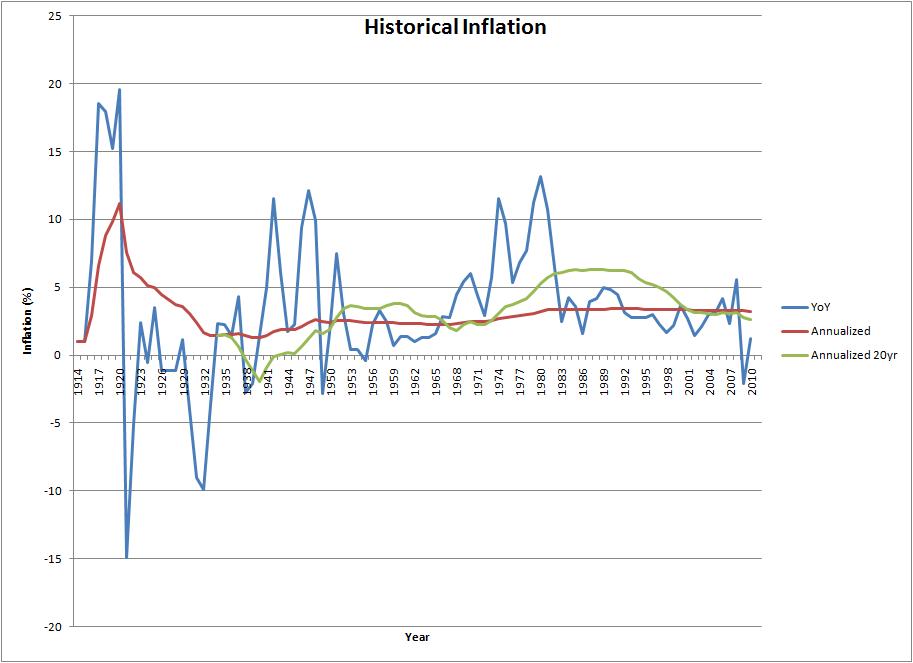
Knowing the current inflation rate is helpful in making short term decisions. Seeing a table of historical inflation rates is only slightly productive. For long term planning, what we're really interested in is the annualized inflation over a period of time. Sure, some years inflation may skyrocket to 20%, but other years it's flat or even negative. Taken together, they should be equivalent to one inflation rate applied each year. This annualized inflation rate (or geometric mean, or Compound Annual Growth Rate [CAGR]) is probably a good value to use when modeling inflation far into the future.

I found some great information over at InflationData.com, but I couldn't find any information on average or annualized inflation. I found a calculator at MeasuringWorth.com, but that also wasn't terribly useful except to give me a single final result. Then I found Peter Dolph on average inflation, but that was unclear whether it gave an average year-over-year inflation, which didn't make as much intuitive sense, or the geometric mean. So, I decided to compute it myself.

Since I love data, I started with the raw CPI data (see one of the tables below). I then computed the annualized inflation rate from 1913 up until each data point using the same month (or average, in the annual case) in each year. Looking at the table, things appeared to level out, so I decided to verify that with a graph! Not content with that, I then added the year-over-year inflation data for comparison purposes. Not content with that, I then computed and added a sliding 20-year window of annualized inflation rates.

The graph above (click for full size) shows the year-over-year inflation rate, a sliding 20-year annualized inflation rate, and an overall annualized inflation rate. Below, you can toggle between the raw CPI data and the overall annualized inflation rate table. The month of July was used for the graph for the simple reason that it was the most recent month data was available for this year. Also, the average 20-year annualized inflation rate was 3.236% compared to the overall annualized rate of 3.239% at the end of July, 2010, and compared to the 3.26% Peter Dolph found to be the average. Things seem to be pretty consistent.

"What about the risk of hyperinflation?" you may ask. Hyperinflation would indeed be bad, but I don't think it's particularly useful to worry about. If hyperinflation hits us, the world economy is likely completely broken and no amount of planning will help. You could argue that real goods like precious metals would hold their value, but I think owners of gold, for example, will have a hard time taking possession of that gold. Just a theory.

So, 3.3% is a pretty reasonable assumption for long term inflation, arrived at using various methods. This should give us some confidence when we create long term models and/or plans!

Display Annualized Inflation Table

Sunday, October 25, 2009

One-Time Expenses

A couple of days ago, my friend and I were talking about many things. One of these things included a comment about one-time expenses and how there seems to be one every month. I decided to analyze my one-time expenses over the past year and see what I can learn about my budget (as informal as it is). So:
  • December: Living room TV: ~$800, second 24" monitor: ~$300.
  • January: Video games: ~$100. Not too bad...
  • February: Ladder to fix the roof: ~200, paying some guy to fix the roof: ~$60.
  • March: No big expenses. Go me!
  • April: Nothing again!
  • May: Fiona died, and I took Apple in to get tests and shots: $130.
  • June: Adopted Mac & Cheese: ~$100, initial vet visit for Mac & Cheese: $110
  • July: Apple's eye infection: ~$50, Mac & Cheese declawed: ~$260, new tennis racquets: ~$230, video games: ~$100.
  • August: I did good again!
  • September: Video games: ~$75, miscellaneous family expenses: ~$200.
  • October: File server parts & digital camera: ~$400.
  • November: Planned car repairs: ~$400

This puts me at just about $300 per month for one-time expenses. I also want to get a new bed at some point, a storm door for the front, a new car eventually, and probably a few other things I have forgotten about while compiling the above list. The storm door will improve the heating/cooling efficiency of the house. The bed, at least, will likely be purchased at Nebraska Furniture Mart (can you believe I used to be anti-NFM at one point?) and therefore be spread out over the following 24-30 months...

I think the video games will also be a less frequent expense for awhile, since a lot of the video game purchases were large packs of games, and should keep me busy for quite a long time, really. There are still at least 10-20 games I haven't even installed/tried. I really hope my pet expenses (one-time, that is - food and litter are frequent purchases) are very low going forward. Regular check-ups only, please! My file server is running much smoother now (see future post), so that will hopefully truly be a one-time expense for the year or more. I remember justifying my living room TV as roommate retention. It's at least getting use. Some car repairs are definitely necessary - I worry about every strange noise I hear when I drive right now, which is not pleasant at all.

...I think what I learned is that even after compiling a list of one-time expenses while expecting a ridiculously high total, I still went into justification-mode after seeing it. I do keep my regular expenses fairly low, and I'm not at all worried about my cash flow. As I discussed previously, I save $200 each month, and that's after maxing out my 401(k) and Roth IRA contributions every year. I save a lot of money each year, and have multiple layers of financial cushions should I ever need to cut back on expenses. However, even if it's not strictly necessary, I think an occasional analysis of spending patterns is helpful.

Update: Speaking of Nebraska Furniture Mart, I forgot about my living room couch. It was purchased on my NFM card, though, and I technically haven't started paying that off yet - I'm still working on my dining room furniture. Or maybe it is my downstairs TV. I love 0% interest! Also, I think it important to mention my new furnace, since it was almost a full year's worth of one-time expenses by itself. Things happen.

Friday, October 9, 2009

Reserve Cash vs Investing

As I discussed awhile back, here, I have a primary E*TRADE Complete Savings account, and a reserve E*TRADE Complete Savings account. I set up a $200/month automatic transfer from my Complete Savings account to my Reserve Cash account quite awhile ago. This was in addition to a sizable initial funding.

So far, this has worked very well at keeping me from investing this cash in (riskier) stocks. For the most part, I think this has worked because the balance of each account is relatively small, so it doesn't feel like I have that much extra to invest. You'll notice that I don't say spend - I have an automatic transfer of $1200/month to my checking account, which covers all credit card transactions plus those utilities not charged to the credit card. This has been more than enough to cover my limited expenses so far. It also helps me keep the few bigger purchases I make, such as buying a new camera, well spaced throughout the year. My main problem in keeping a cash reserve is that I feel that money is wasted just sitting there, when it could be averaging 8% per year sitting in the stock market.

I think this feeling will become a larger issue very soon, when my Reserve Cash account will surpass my Complete Savings account. At that point, I fear it will suddenly appear to be a much larger chunk of money than it is. To combat this feeling, I think I need a specific goal. For example, MyMoneyBlog's author keeps $100K in reserve, which is way too much cash to have on hand (at least for me). If I take my $1200 spending money plus $1400 mortgage payment, I get monthly expenses of $2600. In an emergency, I can take off more than $100 from my mortgage payment, and can easily cut down spending. But, to be conservative, let's leave one month's expenses at $2500 (a small adjustment for nice round numbers).

My first thought is to keep $10K in my reserve account. This would be at least 4 months of expenses, and is a nice round number. Combined with the fact that I always keep at least $3K in my Complete Savings account just in case there's a problem with my direct deposit for a month, this seems like a more than adequate cash reserve. However, never having had an emergency in my life, I'd be interested to hear other perspectives. Is 4 months of expenses a stupidly low cushion, despite most places recommending 3-6 months? How many months expenses do you keep on hand?

Friday, March 6, 2009

Things I Want To Buy #2

This is a follow-up post to Things I Want To Buy.

I didn't end up buying a restringing machine, and gave up the idea after my uncle said it was definitely more trouble than it was worth. I got a new primary computer, but have had some problems with it. Mainly, it runs hotter than my friend's similarly spec'd one. Rather aggravating.

Anyway, an updated list!
  • I still need my deck repainted/stained. I want to get that scheduled by the end of the month, at least.

  • I still need a new electric lawn mower. I plan on giving my old one to my brother for his rental house, and I never want to use it again. Thus, I will need this before I can mow my lawn.

  • I want a storm door for my front doorway. Storm doors are apparently rather expensive, so I may wait until the end of summer, as a warm draft is not nearly as bothersome as a cold draft.

  • At some point, I'll need a new car. My current car keeps getting something else wrong with it. Most recently, I noticed that it no longer beeps at me when my seat belt isn't buckled. This doesn't actually bother me, but it's a sign that the car is aging. I'm hoping to get another year or more out of it, though, especially since I don't drive all that much.

Sunday, July 13, 2008

New computer specs

I've begun purchasing components for my new computer! I'm getting very excited. It will end up very similar to this one: Ultima. I've purchased the ram and power supply in order to take advantage of mail-in rebates that expire on the 15th or so. I will purchase the rest in my next credit card billing cycle, most likely.

Qty. Image Product Description Unit Price Savings Total Price
1
Thermaltake W0116RU 750W Complies with ATX 12V 2.2 & EPS 12V version Power Supply
Thermaltake W0116RU 750W Complies with ATX 12V 2.2 & EPS 12V version Power Supply - Retail
$189.99 -$20.00 Instant, $50.00 mail-in
$119.99
1 SAPPHIRE 100243L Radeon HD 4870 512MB 256-bit GDDR5 PCI Express 2.0 x16 HDCP Ready CrossFire Supported Video Card
SAPPHIRE 100243L Radeon HD 4870 512MB 256-bit GDDR5 PCI Express 2.0 x16 HDCP Ready CrossFire Supported Video Card - Retail
$284.99
$284.99
2 OCZ Reaper HPC Edition 4GB (2 x 2GB) 240-Pin DDR2 SDRAM DDR2 800 (PC2 6400) Dual Channel Kit Desktop Memory Model OCZ2RPR800C44GK
OCZ Reaper HPC Edition 4GB (2 x 2GB) 240-Pin DDR2 SDRAM DDR2 800 (PC2 6400) Dual Channel Kit Desktop Memory Model OCZ2RPR800C44GK - Retail
$99.99 -$8.00 Instant. $35.00 mail-in
$113.98
1 Intel Core 2 Quad Q9450 Yorkfield 2.66GHz LGA 775 95W Quad-Core Processor Model BX80569Q9450
Intel Core 2 Quad Q9450 Yorkfield 2.66GHz LGA 775 95W Quad-Core Processor Model BX80569Q9450 - Retail
$329.99
$329.99
1 LITE-ON 20X DVD±R DVD Burner Black IDE Model DH-20A4P-04
LITE-ON 20X DVD±R DVD Burner Black IDE Model DH-20A4P-04 - OEM
$21.99
$21.99
1 LIAN LI PC-7B plus II Black Aluminum ATX Mid Tower Computer Case
LIAN LI PC-7B plus II Black Aluminum ATX Mid Tower Computer Case - Retail
$119.99 -$30.00 Instant $89.99
1 Western Digital Caviar SE16 WD6400AAKS 640GB 7200 RPM SATA 3.0Gb/s Hard Drive
Western Digital Caviar SE16 WD6400AAKS 640GB 7200 RPM SATA 3.0Gb/s Hard Drive - OEM
$94.99 -$5.00 Instant $89.99
1 DFI LANPARTY DK X48-T2RS LGA 775 Intel X48 ATX Intel Motherboard
DFI LANPARTY DK X48-T2RS LGA 775 Intel X48 ATX Intel Motherboard - Retail
$234.99 -$20.00 Instant $214.99
Subtotal: $1,265.91


Update: The HD4870 has fallen in price to $284.99! $25 saved so far just by waiting!